Friday, November 19, 2010

Defeat or Victory???

facebook is great for quick comments but sometimes “What’s on your mind?” needs a few more words than facebook allows. That’s the case today!


The US media is full of the results of the trial of Ahmed Khalfan Ghailani. For those who have forgotten – or don’t watch TV - Ghailani is the 36-year-old Tanzanian from Zanzibar who was reported to be Osama Bin Laden’s cook/driver. He was accused of 285 counts of assorted terrorism linked to the 1998 Al Qaeda bomb attacks on U.S. embassies in Kenya and Tanzania that killed 224 people. A US civilian court cleared him of almost every charge except that of conspiracy. This alone carries a 20-year jail term.


The pundits are now calling this a defeat for President Obama's drive to prosecute Guantanamo prisoners in American courts and calling for future trials in Military Tribunals. Others are suggesting that because Military Tribunals are also prohibited from recognizing evidence obtain by torture (or should I say, “enhanced interrogation”) there should be no future trails at all. Presumably, detainees, including Khalid Sheikh Mohammed, the self-professed mastermind of the 9/11 attacks, should just languish in cages at Guantanamo forever.


What some call “a rare defeat for the U.S. Attorney's Office in New York, which has a near perfect record in prosecuting terrorism cases”, is to me, a victory for the US justice system. The mark of a great society is not how it treats the privileged. It is how it treats its criminals and those condemned by society. A Federal jury found Ghailani guilty! The system worked! That is why I am so worried by the thought that those currently detained in cages in Guantanamo, Bagrhan Air Base or the “secret prisons” like those suspected to exist on Diego Garcia, might never have an opportunity for justice or to face their accusers. If that happens, then we are no better than the people we call terrorists.


Back in 1215 Magna Carta included the clause that “No Freeman shall be taken or imprisoned, or be disseised of his Freehold, or Liberties, or free Customs, or be outlawed, or exiled, or any other wise destroyed; nor will We not pass upon him, nor condemn him, but by lawful judgment of his Peers, or by the Law of the land”. This was extended to the concept of habeas corpus and is a foundation of all civilized legal systems. It protects you and me from being detained at the whim of the powerful. Our current government has continued the deception of the previous administration by claiming that habeas corpus does not apply to “enemy combatants” in a time of war. This “war” has been longer than WWI, WWII, or the Viet Nam War. There is no end in sight – or even a clear definition of what constitutes victory! We have made a war out of what was a major crime and awarded military status to criminals.


One of the first rules of “problem solving” is to correctly frame the problem. Our government framed 9/11 as a “war” rather than a criminal mass murder. It was our first and biggest mistake. For me, bringing Ahmed Khalfan Ghailani back to a criminal court was a step on the path back to sanity. A guilty verdict and 20-year minimum sentence from a free court was a victory for justice. It was proof that these people are not soldiers or martyrs. They are simply common criminals.


I should have ended on the last sentence, but I fear for my adopted country. Given the recent election results I fear the administration will take the easy route – and continue with the status quo: an unending and unwinnable war. That war will continue to rob us of our bravest and best, increase our debt and abandon the image that “the great communicator” once proclaimed the USA to be; “a tall proud city built on rocks stronger than oceans, wind-swept, God-blessed, and teeming with people of all kinds living in harmony and peace, a city with free ports that hummed with commerce and creativity, and if there had to be city walls, the walls had doors and the doors were open to anyone with the will and the heart to get here”.

Monday, November 16, 2009

Too Much Information . . . .

According to family lore our ancestor, John Malcolm Andrews came to Northern Ireland from Stirling, in Scotland early in the 1700s. He settled to the west of Belfast near Andersonstown and worked in the linen industry. Most of those Scottish immigrants were Presbyterian and they suffered the same discrimination as their Catholic neighbors because they were not members of the "established" Church of Ireland. In fact, many Ulster Presbyterians joined with Catholic Irish to form the United Irishmen and were leaders in the 1798 rebellion. That uprising, like so many Irish rebellions failed. Again, family gossip whispers that one almost forgotten ancestor was hanged as a rebel near Carrickfergus. The "respectable" side of the family stayed close to west Belfast and the linen industry. The 1911 Census of Ireland tells the story of the end of one branch the Andrews family line. This heir had no sons and the Andrews name ended when his six daughters married or died.


(Larger version: http://picasaweb.google.com/plummerspixels/PlummersPixels?authkey=Gv1sRgCO7Wpdygp6OvUA#5404859596594892370 )

On the evening of Sunday, April 2, 1911 Malcolm Andrews, his second wife Jane, and two of his unmarried daughters were at home in Braemar Street, Belfast. Georgina, his third unmarried daughter was visiting her married twin-sister Elizabeth Scott for the night. She is recorded on that family's census form. His other two married daughters Margaret Shanks and Mary Glencross are listed with their families under their married names. Those census forms tell more than who lived where that night almost 100 years ago. That census also records the jobs they held. John Malcolm Andrews' descendents were still tied to the linen industry in 1911. According to the form my grandmother Sarah was a linen weaver. Aunt Georgie was a damask weaver. Aunt Edie was a machinist (she was a "spoke stitcher"), and the majority of Aunt Mary's family also worked in the linen mills. That's not too surprising as almost ten percent of Belfast's population was engaged in the textile industry, people didn't venture too far from home and very, very few had the opportunity to advance from manual labor to a profession.

Those old census forms also show that some things don't change. Great grandfather Malcolm recorded his daughters' jobs simply as Weaver and Machinist. He also recorded that his wife was 62 years old. It took bureaucracy, in the form of Constable Robert Lynch to provide the additional information that Sarah was a linen weaver and Edith was a blouse machinist. And, I am sure that Constable Lynch received a frosty farewell from Great grandma Jane and a cold welcome thereafter when he changed her age from 62 to 65.

Monday, September 28, 2009

Learning to love The Bomb

For the past few days we have been bombarded by a revelation from our “intelligence” agency that Iran has another facility that can be used to develop a nuclear weapon. As expected, Iran has denied this facility has aggressive intents and claiming is has only peaceful purposes. Coupled with this denial is an almost schoolboy attitude from Teheran suggesting, “So what; we’re a free country; you can’t tell us what to do”. On the other side we have “experts” suggesting that a military option to destroy this facility might be a reasonable response to this “provocation”. Coming from nations who already have nuclear weapons our schoolboys are in effect saying, “You are not like us. We can be trusted with this power – you can’t.” Some older folks with long memories might find certain hypocrisy in this position.

There is a very good reason why we call nuclear bombs “weapons of mass destruction”. Other military actions can kill more people (for example, mass firebombing a city) but a nuclear bomb concentrates that force in a single package. A few such bombs can change the course of history. A few bombs change the way nations must treat each other. We see this in the relations between the West and Russia during the 50 years of “Cold War”. We see it in the delicate relations between India and Pakistan even in the face of the recent massacre in Mumbai by terrorists based in Pakistan. At the heart of this delicacy is a belief that nuclear weapons bring the potential for Mutual Assured Destruction – if you destroy me then rest assured that I will also destroy you.

We conveniently forget that Israel already has The Bomb. Israel neither admits nor denies that it has nuclear weapons but their possession is a generally regarded “public secret”. The US has declassified documents indicating it was convinced Israel had nuclear weapons as early as 1975. There are no public records stating how many warheads Israel has now but it is likely to be a significant number. Israel also has a viable delivery system. The Israeli air force is justifiably considered one of the best in the world. Dropping a nuclear bomb in the general vicinity of Teheran, Qom, Shiraz or any other large Iranian town is definitely within their capabilities. I have no doubt that this simple fact has not escaped the attention of Iran’s president, its religious leaders and the majority of its people.

It was widely reported that Nikita Khrushchev threatened to “bury the US”. We cleverly recognized this as hyperbole and continued diplomatic relations with the Russian Premier. We seem incapable of recognizing hyperbole in speeches by Middle Eastern leaders. This is unfortunate because hyperbole is common in those cultures – surely we have not forgotten the “mother of all battles”?

Is Iran seeking a bomb? I expect it is; not because it wants to obliterate Israel but because they probably believe it will bring a level of security and new respect. Both of these are likely to be illusory but if the only policy we have is to isolate Iran then it is not too surprising that they continue act like defiant schoolboys. As for Israel’s security, perhaps they need to recall a key concept from the movie Dr. Strangelove. The whole point - of the doomsday machine is lost...if you keep it a secret! WHY DIDN'T YOU TELL THE WORLD?!

Monday, August 24, 2009

Pandora's Box - 2009


In Greek mythology we are told that Zeus gave Pandora a large jar with instructions not to open it. But, Pandora had also been given the gift of curiosity. Pandora opened the jar. When she did, all of the evils, ills, diseases, and burdensome labor that mankind had not known previously, escaped from the jar. No one has ever been able to put those afflictions back in the box. As I listen to the disclosures about the torture and interrogation techniques that my government has done in my name, supposedly to keep me safe, I am reminded of the story of Pandora.

Since records began they tell the appalling story of torture. A tour of the Tower of London is incomplete without an inspection of the instruments used in Medieval England to obtain information. Similar establishments can be visited in most European capitals and the Spanish Inquisition is synonymous with use of horrific techniques to encourage reluctant suspects to confirm their accusers’ suspicions – regardless of the veracity of those suspicions. For a time, it seemed that human civilization might be advancing because many states, USA included, denounced the use of torture. This hope was reinforced when State sponsored oppression by those of the Gestapo and the Kempi Tai were tried for war crimes after World War II. But the belief that torture is an effective technique in getting information seems impossible to rebut. Torture was as widespread among the right-wing regimes in South America as it was among the left wing governments in Eastern Europe. Now, the contagion has spread into the policies of our democracy.

Of course, we Americans don’t torture. We secure prisoners in “stress positions” – maybe like those in the engraving here that I copied from an early 18th century book on Christian martyrs. We “simulate” drowning and threaten prisoners’ mothers or children. We do this all in the name of protecting democracy, freedom of speech and the American dream. But does it bring any security?

Torture is often justified by the “ticking bomb” scenario. This supposes that the authorities know that a prisoner possesses information that can save large numbers of innocent people from imminent destruction. This is the ultimate “end justifies the means” situation: a situation that can be used by every petty bureaucrat (and even our recent Vice President.) It is also a justification that can turn torture into a normal and accepted procedure. We now face a real danger that bureaucrats will see torture as just another interrogation technique to be routinely used to make sure that “nothing is missed”. It could even lead to a situation where bureaucrats who fail to order torture might be accused of failing to use all reasonable methods to safeguard the public.

There was one good gift in Pandora's Box - hope. I hope we might have a way to banish the evil of torture from our nation. That way is to repudiate the evil that has been done in our name and to deny that the “end can ever justify the means” especially when those means are the antithesis of everything we hold valuable. We need to apply the same legal standards to those who participated in these violations of civilized behavior as we did in 1945. We need to guarantee that authorizing or using torture will end the career of ay bureaucrat who even considers it.

Wednesday, April 22, 2009

Granddaughters

During the past four years we have watched our grandson grow from a tiny baby into an inquisitive, intelligent and confident little boy. Almost a year ago his sister came into the world and again we watched in amazement as a totally different character formed. Then, just three months ago, we were blessed with another granddaughter. Daphne lives closer so we can marvel at the almost daily development of her little personality. Maybe the presence of these young ladies in my life has made me more sensitive to reports of violence against women. Whatever the reason, these reports are a common theme recently.

The first report to catch my ear was on the radio as I was driving to work. The commentator explained that current economic turmoil is increasing the stresses inside many US families. A sign of this stress is an increase in the number of reports of domestic violence and assaults against women. The second nudge was from a totally different source – a photography magazine. There is a reference to Joyce Tenneson in the current issue of Shutterbug. It is illustrated by some posters from her portraits each with the slogan, “When violence against women stops, I will . . . . . .” The subjects’ hopes are usually something most men take for granted, like “I will be able to walk alone”. The latest nudge was a television program about the Taliban restrictions on women in Pakistan. Two little girls showed their school – or rather what remained of their school after those “students of religious knowledge” destroyed it. The father of one girl observed that the goal of this destruction was to chain his daughter’s mind. That statement seared my consciousness because just a few days earlier I took this photograph of one of my favorite bookworms. She may be sitting on the ground but there are no chains on her mind or imagination. They are off with the story in that book. She is flying totally free from the grey world around.

Sadly, even in the USA not everything is wonderful. This bookworm and my granddaughters will face dangers close to home as they get older. It is estimated that domestic partners assault between 2 million and 4 million US women every year. About 25 percent of the female population will be abused in their lifetime. Violence against women is a serious crime in most countries. Yet even in the US there is a perverted belief in some circles that it can be acceptable and even understandable male behavior. I don’t have an answer to that stupidity except more education – especially fathers educating their sons that violence towards women is always a sign of an impotent coward. Maybe we also need to add a dose of public ridicule to the criminal punishment of abusers. The fear of ridicule by one’s friends and neighbors is a great deterrent and a powerful force for changing male conduct. Ridicule might even highlight the moral bankruptcy of the Taliban and lead to faster changes in their behavior than current political policies (which only seem to bring them more recruits).

I also admit I just do not understand how any person who beats women can claim to be a “man”. It is certainly not Christian conduct. Regardless of religion, at a fundamental level, it is simply uncivilized. Maybe that is the answer. Those who abuse women are just not civilized and certainly not honorable. I have no difficulty accepting that description for the Taliban. Honesty also forces me to accept the same description for many of my countrymen. That realization means I, and anyone else reading this, must always be vigilant to make sure all our daughters and granddaughters can grow in freedom so that violence is never a part of their lives.

Friday, January 2, 2009

Changing attitudes – or just changing words??

I always enjoy going to church at Christmastime. The familiar Bible stories bring a lump to my throat and I love to sing the carols that I learnt when I was a child. Nobody has ever accused me of being a tuneful singer but that doesn’t stop me from belting out those familiar words – and therein lies a problem. Those familiar words just aren’t familiar any longer. The language in some of my favorite hymns has been rendered “gender neutral”. Last Sunday, we sang that old favorite “Hark the Herald Angels Sing”. I haven’t needed to refer to a hymnal for those words since I was about eight years old. So, there I was, singing “pleased as man with man to dwell” while the choir and most of the congregation sang “pleased with us in flesh to dwell”. At least we both agreed that Jesus was “our Emmanuel”.

Another of my favorite hymns is the old Irish classic, “Be Thou my Vision”. Again, I learnt the words of that hymn many, many years ago and in today’s material world the original phrase “Riches I heed not, nor man's empty praise” always make me stop and think about the motivation for my actions. Nowadays, the hymnal reads, “Riches I heed not, nor vain empty praise”. Removing the focus from the source of that empty praise has, in my humble opinion, dramatically weakened that stanza – and the struggle for the right motive for service.

As I formulated my usual silent tirade about people who see problems where none exist and change what is not broken I started to wonder if maybe I was the one who was insensitive. Are there women who see mainstream Christianity as inherently sexist, dominated by the masculine gender and discriminating against anything feminine? Is my attitude to these changes an example that “I don’t get it?” If so, maybe I am equally insensitive to other forms of discrimination. I am a white Anglo-Saxon Protestant. I am over 6 foot 3 inches tall. I was blessed with reasonable intelligence, was brought up by loving parents, went to collage, got married and have been reasonably successful in careers. All these attributes and experiences must tinge my attitudes. Can I really understand the situation of people of color, short people, Roman Catholics in Ireland, those without education or a job? There are lots of “shoes” I have not walked in and I suppose lots of attitudes and opinions that I don't (or can’t?) really understand.

So, as 2009 starts, my first resolution is to try not to react when change comes - especially to those things I consider should be carved in stone. I admit that I will have a hard time un-learning some of that "sexist" language in those old hymns. But, if any of my readers suspect that maybe my opinions or attitude in other areas might also be due for a change, just drop a gentle hint into the conversation – maybe a code word - like “Luddite”

Monday, November 10, 2008

thoughts on Veterans' Day

Tomorrow is the anniversary of the armistice that ended the horrors of World War One. At the eleventh hour of the eleventh day of the eleventh month the guns fell silent. Since then, November 11 has been set aside as a day to remember all those who gave their lives in the armed forces for our freedoms. In UK, people mark that day by wearing a red paper poppy. (The poppy thrived in the soil between the trenches of Flanders that was torn up by bombs and shells. It was adopted as the symbol of the horrors of War.) That tradition is still strong. On the way to the airport in Tokyo today I saw several westerners wearing poppies in the lapels of their business suits. Here in the US we will celebrate “Veterans Day” to remember those who served for our freedoms. There will be ceremonies and maybe even parades, but often the focus will be on “past” wars. It is easy to remember the “acceptable” conflicts of WW II, Korea, and nowadays, even Viet Nam. Those wars are safe. The conflict has ended, the pain is past and the horrors are safely confined to movies and television documentaries.That is not true of the present conflict in Iraq.

On a recent visit to Calgary I noticed that the flags at the airport were flying at half-staff. It was not a special holiday and the newspapers had no reports that an eminent citizen had died. The reason was that a member of the Canadian armed services who had been killed overseas was returning home. I confess that I thought this was a “nice” gesture and continued on my way. Tonight I watched a TV report about how the ordinary Canadian people pay their respects to Canada’s fallen. The article made me compare the way Canada acknowledges its fallen with the air of secrecy that surrounds the sacrifice by the US forces. Here, we are regularly informed about numbers. The trouble is (or maybe the point is) we are immune to numbers. An article that four soldiers were killed by an IED evokes no response. The sight of those four bodies returning home, four flag draped coffins, grieving families, distraught children and the effect this has on four different communities might make us appreciate the full cost of this futile war.

We rightly ridicule government attempts to stifle news and feed propaganda to its citizens. When that is our government’s policy and it also negates the full sacrifice of our fallen, it is unconscionable.

I memorized this verse at school in the 50s when the horrors of WWII were still visible in Europe. My teacher was an "old" lady. She probably shared in the sacrifices of WW I. The thoughts it expresses are still applicable to the heroes of today.

They shall not grow old as we that are left grow old,
Age shall not weary them, nor the years condemn
At the going down of the sun and in the morning
We will remember them.

For the Fallen
Laurence Binyon (1869-1943),

Tuesday, November 4, 2008

Brothers in Arms . . . usually a waste

I am writing this entry on the plane as it flies over Alaska on the way to Japan. I suspect that if I look out of the windows on the right side I might see Sarah Palin’s house and if I check the other side I might see Russia. Right now, I’m quietly marveling at the technology all around me. My laptop is plugged into a 120V outlet in the seat, an LCD screen in arm-rest offers a choice of over 300 movies or I can select my favorite tracks from over 200 CDs. The music selection is wonderful: everything from Elvis to Enya or Bach to Billy Holiday. Outside, it is -60 degrees Fahrenheit but I am cocooned in an aluminum tube hurtling towards the international dateline at 550 miles per hour listening to Simon and Garfunkel sing about the “Sounds of Silence”.

The music system allows passengers to select tunes from any number of CDs and play a personal “Jukebox” to wile away the hours. Among the gems I’ve included on my jukebox is “Brothers in Arms” by Dire Straits. I can’t listen to this tune without being grateful for the circumstances in my life. My parents were both in their late teens and early twenties when they served in the armed forces during WW II. I was born at the end of that war and came of age when the law requiring two years service in the forces had been abolished. The UK was not involved in Viet Nam so unlike some of my colleagues here, I was spared that conflict. Now, I am too old. My son registered for Selective Service when he became 18 but as the years pass and he advances I have strong hopes that he will be spared any involvement in armed conflict. I fervently pray that my grandson and granddaughter will also be spared. That’s her picture at the end of this paragraph. She is still too young to be embarrassed by a doting granddad or be teased by friends. I’m not too sure that applies to her “big” brother so we’ll omit his photo.)

I expect many people will think my feelings are selfish. Maybe they are, but they are also a combination of profound sorrow and deep anger. Sorrow for the wanton loss of youth and all the wasted potential those lives contained; anger at the people my age who keep failing to find alternative means of solving problems and so squander those youthful lives. My feelings are not restricted to the US. I mourn the loss of youth on all sides and my curses are democratically directed at all leaders. But the crux is we claim to have higher ideals than some other folks.

So, I also get angry each Sunday when, with so many other American citizens, I go to church to worship the “Prince of Peace”. We recall the way Jesus forgave His killers. We read and memorize verses proclaiming His teaching that love conquers all and somehow, we manage to rationalize that these words are not really intended to work in the real world between Monday and Saturday. Should I add naivety to my selfishness? I don’t have an answer to that but I am sure that we cannot just pick the bits of Jesus’ teachings we like and ask forgiveness when we deliberately ignore the “inconvenient” parts. The verse is “do onto others as you would have them do onto you”. That way will bring security for everyone’s grandkids. Unfortunately, too many seem to read it as “do onto others before they do onto you”. That is a guaranteed path to continued waste and sorrow.

Monday, October 13, 2008

Religious education

Back in the Dark Ages when I attended the Boys’ Model School in Northern Ireland, the law required pupils be taught two specific subjects. They were subjects that are not normally required for a good education in USA today - Religious Education and Physical Education. I thought that the “Troubles” in Northern Ireland and the development of modern curricula would cause a retreat from teaching religion to all pupils. However, looking at the current website for the Boys’ Model, I was very surprised to read, “The legal requirement is for every pupil to study RE, unless parents request his withdrawal.”

The school webpage covering Religious Education makes some interesting claims for the subject. These include “a substantial contribution to the spiritual, moral, cultural, intellectual and physical development of all pupils.” Certainly much of Western culture and the basis for our ethical systems tie directly back to our religious heritage. Still, I wonder about that claim for “physical development.” Maybe the author was thinking about the admonitions against strong drink and immorality.

The webpage notes the goals of the RE course. They include the usual communication, thinking skills and personal capabilities. They also include:
  • a knowledge of where religious and moral beliefs come from;
  • an awareness of Christian teaching;
  • a sensitivity towards the beliefs of others;
  • an ability to think and judge about morality;
  • an awareness of self.
Those seem to be pretty basic skills for anyone growing up in today’s world. The course includes an “Introduction to Judaism & Islam” so the content looks as relevant as the latest news. Given our concerns about moral, ethical and business standards, I wonder if this is another small example of “How the Irish Saved Civilization”.

Friday, October 10, 2008

Harvey - Guest Blogger

We Bull Terriers are a naturally retiring breed but as I lay on the sofa with one ear cocked towards the television I became so incensed that I asked Fergus if I could post this note. The pundits on CNN suggested that some humans might choose whom to vote for based only on the color of a man’s skin. I couldn’t believe it. I don’t understand it. I thought I heard that something called the Stock Market had lost 40 percent of its value; lots of people have no jobs; others can’t afford to go the vet (sorry, doctor); and many are loosing their homes. How does chosing a President based on skin color help solve these problems? My friend Regan is different from me. She is a Grey Hound. She has colored patches and very long legs. But we get on together – even if she does always want to be the boss.

I was told that humans are more intelligent than us dogs. Now I am not so sure. Please, humans, decide the future of this country on something more important than the color of a man’s skin.

Tuesday, October 7, 2008

Ike - Finale

It’s been three weeks since Ike left town. Our part of Missouri City is almost normal – except that all the Bradford Pear trees have decided it is spring again and have come into flower. How one night of high winds can induce the same response as four months of winter is perplexing but the blossom adds a touch of wonder to what was an unpleasant experience.


The beach home in Galveston fared very well. Dirt marks on the garage wall indicate that the storm surge on the west of the island was about five feet above ground level – probably about eight feet above normal high tide. The dwelling area upstairs is comfortably above that level so we were spared any water damage except in the garage. Power and water were restored to our area of Sea Isle last week and we were able to power-wash the mud out of the garage. The next test will be to return the batteries to the golf cart and see if it can be restored to operation. All this is very trivial and mundane and our feelings of relief and “survivor guilt” grow each time we travel down to Galveston. During the past couple of weeks people have begun the clean-up process. Along the side of the roads in Galveston (and surprisingly along some parts of Highway 6) heaps of debris are growing. These piles of ruined fridges, sodden furniture, saturated walls and broken structures represent people’s lives, their homes and hopes for the future. I can’t imagine the heartache of seeing a lifetime of memories destroyed or the stress of dealing with insurance claims and bureaucracies - all while trying earn a living and maintain a semblance of normality. Somehow, sending $700 billion to Wall Street to try to fix a crisis caused by greed doesn’t seem to be an appropriate use of our resources. I appreciate my congressman’s fortitude in voting against the bill both times it came to the House. I only wish my senatorial representative displayed the same backbone.

And now for something different . . . . a gratuitous commercial plug. For years I have been a fan of Venezuelan rum. It has a distinctive flavor that is very different from other Caribbean products. IMHO it is infinitely superior to the mass produced liquors (especially the ones with the bat trademark) sold in most US bars and restaurants. But recently I discovered something even better. It is “hand made Texas Rum” produced near here in San Leon on Galveston Bay. Railean distillery has survived Hurricane Ike and their nectar is readily available in your local Specs store. A recent article in the Houston Chronicle describes some of the eccentric residents of San Leon and their efforts to recover after Ike. I encourage y’all to help San Leon in a practical way. Get rid of all those imported rums. Help local industry and our national economy which needs all the help it can get. Be patriotic - Drink Texas rum!

Thursday, September 18, 2008

Ike – interim


It is amazing to watch nature. Ike’s winds shredded leaves on most of our rose bushes but the buds continue to bloom as if nothing had happened. They are certainly more restful than images of splintered trees or piles of downed branches and the media have enough photographs of distraught people and destroyed homes. If you are interested then check out this series at the Boston Globe.

Ike blew in early on Saturday morning (Sept 13). He destroyed much of Galveston and wreaked havoc on Houston. By mid morning the worst winds had passed and folks were able to survey the damage. Our electricity ceased about 2:00 AM during the storm so the neighborhood was quiet without the background hum of air conditioners. Our home in Missouri City fared well with only one large pear tree succumbing to the winds. Two-thirds of that tree was lying on the grass and the remaining sticks and the stump will need to be removed and replaced.

Several years ago we invested in a gasoline-powered generator and I installed a transfer switch which allowed the generator to feed kitchen circuits for lights, refrigerator, microwave, and coffeemaker and those for the lights, TV and overhead fan in the family room. By chance, those same circuits also provided lights in the toilet and bathroom. So, by mid-day on Saturday we were able to have hot coffee and watch the full scale of destruction unfold on TV.

Mains electricity was restored to our part of Missouri City by Sunday afternoon so the generator was dispatched with a friend living in a part of the city still without. Now we are experiencing increasing “survivor guilt” as we sit in air-conditioned comfort watching the plight of those who still don’t have power. N & T are part of that group so along with their greyhound they moved in. TV announcements suggest their part of Houston (the NE) won’t have power restored until sometime next week – about 10-12 days after Ike struck.

As for our home on Galveston there is no official news. However, Google Earth has a new feature. It allows "before" and "after" pictures of Ike. We can see our home and it looks like the roof is intact! The planned “Look and Leave” program to allow residents to visit property, assess damage and depart is suspended indefinitely. Hopefully it will be resurrected again soon – maybe with staggered days based on name or house number to even out the first mad rush of visitors. In the meantime we watch every helicopter news video and wait for the time when we will be able to resume weekends in Galveston.

Friday, September 12, 2008

Waiting for Ike


Hurricane Ike is getting close. We closed up the house on West Galveston and left it to the tender mercies of the elements. Even on Thursday morning at sunrise the storm surge was beginning to show. This photo is where we normally park the golf cart when we visit the beach. I assume that the whole of Sea Isle is under water by now.

Here in Missouri City late Friday evening the wind is picking up. The city has introduced a dusk to dawn curfew but I have no inclination to wander outside and see what is happening. The generator has gasoline in case we loose power; we have water in the bath in case the treatment plant is flooded and we are waiting patiently for Ike to pass. At current speed, Ike should be a memory by this time tomorrow. That will be time to clear up here and wonder if we can get down to Sea Isle on Sunday afternoon.

Monday, August 25, 2008

Doors

This gate at the Harland & Wolf shipyard in Belfast continues to pique my interest. To me, the iron retains its strength and beauty but as I look at the photograph I could kick myself for not taking more time to study the construction. Some parts of the gate look like wrought iron while others are clearly cast. Where they made in the shipyard or is there a name of an artist or foundry inscribed somewhere among those weeds? When were they fabricated? I assume it was sometime after WW II because most ornamental iron railings and gates were collected at the start of the war and turned into steel for munitions. I hope they are still there next time I visit Belfast and I can get some answers.

Doors hold a fascination for me. There are intrinsic differences in function, form, and construction. Equally, doors are wonderful metaphors. What allusions can be drawn from a neglected shipyard gate surrounded by rampant weeds?

The last couple of doors are from churches. The first is at the church located in Jerusalem where the Pool of Siloam is thought to have been. Those closed doors reminded me of the quatrain by Omar Khayyam:

There was a Door to which I found no Key:
There was a Veil through which I could not see:
Some little Talk awhile of Me and Thee
There seemed -- and then no more of Thee and Me.

The second is at one of the missions in San Antonio. I really don’t think there is any significance to the fact that one is open while the other is closed. But then, that’s what makes doors such a fascinating subject – they make me think.


Sunday, August 10, 2008

From the auld country

There are lots of direct flights between Houston and Gatwick. However, a detour via Newark allowed a stop in Belfast to visit my aging mother and offered a reduction in the ticket cost. That opportunity to be a dutiful son and a cost-conscious employee is too good to be missed.

Northern Ireland is a strange mixture of change and stability. On the side of “change” guided bus tours transport camera-clicking visitors up the Falls and down the Shankill to record the sectarian murals that that are now tourist attractions. On the side of stability and “nothing changes” are the loyalist flags remaining from the recent celebration of “the Twelfth” and the news reports that the “Apprentice Boys” marched at Londonderry (or Derry) yet again on Saturday.


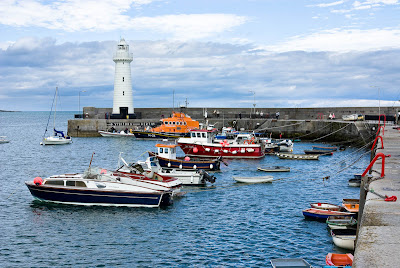
The same mixture of change and stability applies to the landscape as well. Donaghadee is a small fishing village near Belfast. The old folk-song claims that it is “six miles from Bangor to Donaghadee” but that must have been before the ring road was built. Nowadays, it is a little further but once there, the scene is the same as it was when I visited as a little boy. Global positioning has probably made the lighthouse redundant but a lifeboat is still based in the harbor and adds a splash of special color.


In Belfast, the iconic gantry cranes at the Harland & Wolf shipyard also add a splash of color to the skyline. Sadly, they now preside over a relatively silent workplace. It looked like the yard was doing some repairs to a small jack-up rig. That didn’t need the services of these gigantic cranes. These beautiful neglected wrought-iron gates are a sign of the shipyard’s former prosperity. Their sad decay is likely to be an indicator of the fate of these cranes. The curse of geography that puts Ireland at the western edge of Europe has always added to costs and probably will continue to doom the yard to slow decline.

Tuesday, July 22, 2008

Flying

Modern cameras are wonderful. Automatic exposures, automatic focus and shake reduction tempt one to mount a long zoom, point and shoot. I have been doing just that as I walked along the beach at Galveston snapping birds. The results were not very satisfactory. By taking lots of shots the law of averages came to my assistance and I was able to find some that were worth keeping. However, none captured the feelings I was hoping for. Last weekend, I thought about some of the basic photography principles that apply to the shots I was trying to take.

First, I was using a 70-210mm zoom lens set at maximum zoom. On the Pentax K10D this lens has the same properties as a 100-300 mm zoom on 35 mm film camera. For reasonable sharpness, the rule of thumb is to set the minimum shutter speed at 1/focal length. For my lens that should have been at least 1/300 of a second. In “automatic” mode my camera was setting the shutter speed to 1/250 of a second. That’s not a big difference if my subjects had not been moving but it was likely enough to cause some of the blurred details I was seeing. So last weekend I took back some control. I set the shutter speed to 1/500 of a second. I also increased the ISO setting from 100 to 200 so that the f-stop and depth of focus didn’t change. This guy is close to what I have been looking for.


I am in awe of the way the gulls are so at ease as they float on the sea breezes. Just a flick of a feather is enough to set them gliding over the waves to capture a different air current. High over the beach, frigate birds wheeled and turned last Sunday. They were just like so many U2 spy planes while lower down, squadrons of pelicans made effortless “Dawn patrols” along the shore line. They are all in total control of every puff of air. It is easy to understand why we are so fascinated by flight.

As I sat watching them I remembered a poem written in 1941 by an Anglo-American pilot who flew a Spitfire in England for the RCAF. This was before the USA entered WW II. He was killed a couple of months later in an air crash. President Regan quoted the ending stanza after the Challenger disaster, but the earlier lines capture the sheer exhilaration of flying. I know those birds feel that exhilaration.

High Flight
Oh! I have slipped the surly bonds of earth
And danced the skies on laughter-silvered wings; Sunward I've climbed, and joined the tumbling mirth Of sun-split clouds - and done a hundred things You have not dreamed of - wheeled and soared and swung High in the sunlit silence. Hov'ring there I've chased the shouting wind along, and flung My eager craft through footless halls of air. Up, up the long delirious, burning blue, I've topped the windswept heights with easy grace Where never lark, or even eagle flew - And, while with silent lifting mind I've trod The high untresspassed sanctity of space, Put out my hand and touched the face of God.

Pilot Officer John Gillespie Magee
No 412 squadron, RCAF, 1941

Thursday, July 17, 2008

More thoughts on oil supply – and still no pictures

“Fungible” is an interesting word. The dictionary defines it as “being of such nature or kind as to be freely exchangeable or replaceable, in whole or in part, for another of like nature or kind.” Crude oil is a fungible commodity. Differences in quality affect prices and influence the best refinery for processing. But, in simple terms the world’s supply of crude oil can be considered as one large pot. Picture the producers pouring their oil into the pot and the users sitting around like kids sucking it out with straws. New discoveries make the pot bigger. Increasing demand is just those users sucking harder.

So what happens when we discover all that oil offshore that our politicians keep talking about? If the discoveries are big enough to meet our needs and we keep it to ourselves we become independent. That is a dream. More likely, discoveries will be much less than our needs. Again, if we keep that oil to ourselves we may not have to suck so hard from the communal pot. As Mr. Micawber’s economics suggested, we might achieve happiness. More likely, others will suck what we leave and there will be no change in the price of oil.

People are beginning to realize and accept that it will take five to ten years to develop any oil found in the new drilling areas. I wonder if they realize how much oil they will need to find to make any difference. This table shows some numbers taken from the data on the US Department of Energy website. I’ve selected the figures from 2007 and also those forecast for 2015 – when those “discoveries” might be arriving at the pump.

This table only shows three countries – USA, India and China. I have assumed that conservation allows us to reduce our oil consumption by 10 percent in the next 7 years. I have also assumes that India and China will only increase their oil per capita consumption by 10 percent during this time. (As the people of India and China become more affluent they will rightly expect the same standards as those of the West. My assumption of their demands may be very low). Adding the daily demands of just these three countries we see that it grows from 31 million barrels in 2007 to 36 million barrels in 2015. That pot will need to grow by an extra 5 million barrels per day just to meet the needs of US, China and India.

The largest oilfield in the USA is Prudhoe Bay in Alaska. It produces about 400,000 barrels per day. The biggest oilfield in the world is the Ghawar field in Saudi Arabia. Even it only produces about 4 million barrels of oil each day. The whole of Iran produces only 4 million barrels per day. Our politicians might hope the oil industry can discover another Prudhoe Bay. It is statistically unlikely that they will find another Ghawar. The demands of people sucking from that communal oil pot are getting bigger each day. It is obvious that the solution to our (and the world’s) energy problems has to be found outside the oil industry.

Monday, July 14, 2008

Thoughts on Oil - and no pictures

Wilkins Micawber in Charles Dickens’ novel, David Copperfield is famous for his statement, “Annual income twenty pounds, annual expenditure nineteen nineteen six, result happiness. Annual income twenty pounds, annual expenditure twenty pounds ought and six, result misery.

The website of the Energy Information Administration allows us to apply this principle to crude oil prices. Data published on July 8, 2008 show world petroleum production of 86.48 million barrels per day. World consumption is calculated at 86.40 million barrels per day. If these figures are accurate the result for 2008 should be happiness. Forecasts for 2009 are not so rosy. World petroleum consumption is estimated to be 87.72 million barrels per day and consumption will be 87.76 million barrels per day. Mr. Micawber’s statement suggests misery in 2009. Obviously, nobody believes Government statistics for 2008 so crude oil is priced above $140 per barrel instead of happier levels. Misery could be here to stay.

Micawber logic predicts that happiness will only return if we increase production or reduce consumption. Our politicians have made loud proclamations about increasing production. They talked about drilling off the East and West Coasts and in the Alaskan Natural Wildlife reserve. A few sensible ones noted that even if this drilling found oil tomorrow it would probably take seven or eight years to bring the new oil to market. Domestic drilling is not going to restore the production/consumption balance. Overseas production increases might be possible in a shorter timetable. Venezuela’s Orinoco basin has about 1.2 billion barrels of extra-heavy oil in place. Venezuela exports about half a million barrels per day of this oil. The Venezuelan government has plans to significantly increase this volume. However, even here, where the oil location is known, the extraction technology is proven, and the environmental concerns are easily addressed, new production will take at least six years to come on stream. A similar situation probably exists in Saudi Arabia where increasing production from declining oil fields is unlikely to be as easy as the newspapers imply.

A different chorus of folks has stated, “we can’t drill our way out of this crisis”. If they had qualified this sound bite by adding “in any realistic timetable and at a reasonable price” they would probably be more correct. (But $145 dollar oil and lots of time can make even harebrained schemes look sensible.) The real answer for us is to reduce our consumption. In the US we use vast quantities of petroleum compared to other nations. We consume 20.7 million barrels per day compared to China’s 6.5 and India’s 2.4 million barrels per day. On a per capita basis those statistics look even worse. We use 70.6 barrels/1,000 people per day. China uses 2.3 and India 5.1. As the living standards in those countries continue to rise demands for petroleum will also increase – maybe to levels like the 30 - 40 barrels /1,000 people used by many countries in Europe? For the long run, it is unlikely that there will ever be enough oil again to satisfy Mr. Micawber’s requirements for happiness.

Wednesday, July 9, 2008

Just Gulls

I have been remiss in writing this blog because other things have taken priority. Even the camera had to take a back seat recently. Last weekend was the first opportunity to try out a couple of lenses that a friend from church passed on to me. These had been unused for years after his broken Pentax film camera was pronounced uneconomic to repair. But, a feature of Pentax DSLR cameras is that they will operate with most old Pentax lens and so I gratefully attached them to the K10D and tried my hand at photographing the gulls on Galveston beach. It was a learning experience and as I deleted over 60 percent of the shots I was glad that I was not paying for film.

Looking at some of the initial “keepers” I noticed marks and smudges at the same position on each image. There was dirt on the camera sensor. Being able to make “repairs” with Lightroom software reinforced the joys of shooting digital. Hopefully, this weekend will offer another chance to practice with that zoom lens and capture the Laughing Gulls - this time with a clean sensor.

Friday, May 23, 2008

Gratuitous plugs - no politics

At one time “diplomacy” was defined as discussion, persuasion and maybe even subtle coercion used to reach national goals. It required meeting and talking with people of different viewpoints and ambitions. In extremes, it was even necessary to deal with people who sought your ruin. Diplomacy was the skill of solving problems without the use of overt force. In recent years, US leaders have abandoned this traditional definition of diplomacy. Now, our top leaders revile and insult anyone who proposes to meet with people who actively oppose us and can be defined as “terrorists”. Our diplomatic skills are reduced to meeting with those who share our opinions and bombing those who don’t! But just as the decline in the value of the dollar has reduced US world economic influence, so this decline in our diplomatic skills reduces our ability to influence world events. We have lost our position of a respected leader. Our politicians now act more like loud-mouthed bullies.

I was going to continue with examples of respected past leaders who had real diplomatic skills. These leaders dealt with people who might today be called terrorists (or worse) to gain our national objectives. But why should I waste time? The blunders of our current leadership are obvious to anyone with an IQ over 85. This includes diplomacy. Instead, the rest of this epistle is a gratuitous plug for bull terriers.


In many places bull terriers get a bad rap. J’s family had bull terriers when she was a girl and they have always been an important part of our family. We currently share our life with Harvey. This photo was taken after he had a cyst removed from his neck. Harvey is a miniature white English bull terrier. He is instantly recognized by anyone who watched certain beer adverts or who shops in Target. Harvey is small in stature but he displays all the personality and character traits that make bull terriers so loved. Harvey also displays some of the other qualities that can make bull terriers so misunderstood. On the positive side, he is a loving 30-pound lap dog. He is happiest when he is cuddled up beside me watching TV. Harvey behaves just like a strong-willed child. He is precocious, disobedient and is always trying to have things his way. There is nothing in Harvey’s character to give any concern that he would hurt anyone. But, Harvey is a bull-terrier. He is built like an Abrams tank. Those 30 pounds are all solid muscle and bone. His jaws are like a clamp and his tail thrashes from side to side like a cudgel. Harvey doesn’t go around obstructions. He goes through them or shoves them aside. Harvey is like a sumo wrestler who has not learnt to control his strength. This can be a problem when he meets new people, especially young people. Small children are likely to be overwhelmed (and overturned) by his affectionate greetings. For that reason, we always keep Harvey under close control when children ask to meet him.

Harvey is the latest in a line of Bull Terriers and Pit Bulls who have shared our home. They each deserve their own entry in this blog, especially Cleopatra, a red-nosed red Pit Bull and a gentle soul. Throughout her life Cleopatra was ruled by our small Burmese cat who was only one tenth her size. Harvey, Sparky, Cleopatra, Honey and Marquis were all dogs who shared our home at different times. In their dealings with J and me, our children, the neighborhood kids and visitors, these bull terriers showed me that bad dogs are rare – even (especially?) bull terriers. When a bull terrier goes bad, the fault is almost always with the owner.

The personality and character of most bull terriers means that they are not the right dog for every family. Sensible dog lovers recognize this fact. The same statement can also be made for many other breeds – Rottweilers, German Shepherds, for example. Maybe a time is approaching when a dog license should be for a type and size of dog. Just as some people do not qualify for a firearms license, so some people should not be licensed to keep certain dogs. That may sound outrageous, but is it any more outrageous than the suggestion that diplomacy does not require we deal with those we call terrorists?