Showing posts with label Belfast. Show all posts

Monday, November 16, 2009

Too Much Information . . . .

According to family lore our ancestor, John Malcolm Andrews came to Northern Ireland from Stirling, in Scotland early in the 1700s. He settled to the west of Belfast near Andersonstown and worked in the linen industry. Most of those Scottish immigrants were Presbyterian and they suffered the same discrimination as their Catholic neighbors because they were not members of the "established" Church of Ireland. In fact, many Ulster Presbyterians joined with Catholic Irish to form the United Irishmen and were leaders in the 1798 rebellion. That uprising, like so many Irish rebellions failed. Again, family gossip whispers that one almost forgotten ancestor was hanged as a rebel near Carrickfergus. The "respectable" side of the family stayed close to west Belfast and the linen industry. The 1911 Census of Ireland tells the story of the end of one branch the Andrews family line. This heir had no sons and the Andrews name ended when his six daughters married or died.


(Larger version: http://picasaweb.google.com/plummerspixels/PlummersPixels?authkey=Gv1sRgCO7Wpdygp6OvUA#5404859596594892370 )

On the evening of Sunday, April 2, 1911 Malcolm Andrews, his second wife Jane, and two of his unmarried daughters were at home in Braemar Street, Belfast. Georgina, his third unmarried daughter was visiting her married twin-sister Elizabeth Scott for the night. She is recorded on that family's census form. His other two married daughters Margaret Shanks and Mary Glencross are listed with their families under their married names. Those census forms tell more than who lived where that night almost 100 years ago. That census also records the jobs they held. John Malcolm Andrews' descendents were still tied to the linen industry in 1911. According to the form my grandmother Sarah was a linen weaver. Aunt Georgie was a damask weaver. Aunt Edie was a machinist (she was a "spoke stitcher"), and the majority of Aunt Mary's family also worked in the linen mills. That's not too surprising as almost ten percent of Belfast's population was engaged in the textile industry, people didn't venture too far from home and very, very few had the opportunity to advance from manual labor to a profession.

Those old census forms also show that some things don't change. Great grandfather Malcolm recorded his daughters' jobs simply as Weaver and Machinist. He also recorded that his wife was 62 years old. It took bureaucracy, in the form of Constable Robert Lynch to provide the additional information that Sarah was a linen weaver and Edith was a blouse machinist. And, I am sure that Constable Lynch received a frosty farewell from Great grandma Jane and a cold welcome thereafter when he changed her age from 62 to 65.

Monday, October 13, 2008

Religious education

Back in the Dark Ages when I attended the Boys’ Model School in Northern Ireland, the law required pupils be taught two specific subjects. They were subjects that are not normally required for a good education in USA today - Religious Education and Physical Education. I thought that the “Troubles” in Northern Ireland and the development of modern curricula would cause a retreat from teaching religion to all pupils. However, looking at the current website for the Boys’ Model, I was very surprised to read, “The legal requirement is for every pupil to study RE, unless parents request his withdrawal.”

The school webpage covering Religious Education makes some interesting claims for the subject. These include “a substantial contribution to the spiritual, moral, cultural, intellectual and physical development of all pupils.” Certainly much of Western culture and the basis for our ethical systems tie directly back to our religious heritage. Still, I wonder about that claim for “physical development.” Maybe the author was thinking about the admonitions against strong drink and immorality.

The webpage notes the goals of the RE course. They include the usual communication, thinking skills and personal capabilities. They also include:
  • a knowledge of where religious and moral beliefs come from;
  • an awareness of Christian teaching;
  • a sensitivity towards the beliefs of others;
  • an ability to think and judge about morality;
  • an awareness of self.
Those seem to be pretty basic skills for anyone growing up in today’s world. The course includes an “Introduction to Judaism & Islam” so the content looks as relevant as the latest news. Given our concerns about moral, ethical and business standards, I wonder if this is another small example of “How the Irish Saved Civilization”.

Monday, August 25, 2008

Doors

This gate at the Harland & Wolf shipyard in Belfast continues to pique my interest. To me, the iron retains its strength and beauty but as I look at the photograph I could kick myself for not taking more time to study the construction. Some parts of the gate look like wrought iron while others are clearly cast. Where they made in the shipyard or is there a name of an artist or foundry inscribed somewhere among those weeds? When were they fabricated? I assume it was sometime after WW II because most ornamental iron railings and gates were collected at the start of the war and turned into steel for munitions. I hope they are still there next time I visit Belfast and I can get some answers.

Doors hold a fascination for me. There are intrinsic differences in function, form, and construction. Equally, doors are wonderful metaphors. What allusions can be drawn from a neglected shipyard gate surrounded by rampant weeds?

The last couple of doors are from churches. The first is at the church located in Jerusalem where the Pool of Siloam is thought to have been. Those closed doors reminded me of the quatrain by Omar Khayyam:

There was a Door to which I found no Key:
There was a Veil through which I could not see:
Some little Talk awhile of Me and Thee
There seemed -- and then no more of Thee and Me.

The second is at one of the missions in San Antonio. I really don’t think there is any significance to the fact that one is open while the other is closed. But then, that’s what makes doors such a fascinating subject – they make me think.


Sunday, August 10, 2008

From the auld country

There are lots of direct flights between Houston and Gatwick. However, a detour via Newark allowed a stop in Belfast to visit my aging mother and offered a reduction in the ticket cost. That opportunity to be a dutiful son and a cost-conscious employee is too good to be missed.

Northern Ireland is a strange mixture of change and stability. On the side of “change” guided bus tours transport camera-clicking visitors up the Falls and down the Shankill to record the sectarian murals that that are now tourist attractions. On the side of stability and “nothing changes” are the loyalist flags remaining from the recent celebration of “the Twelfth” and the news reports that the “Apprentice Boys” marched at Londonderry (or Derry) yet again on Saturday.


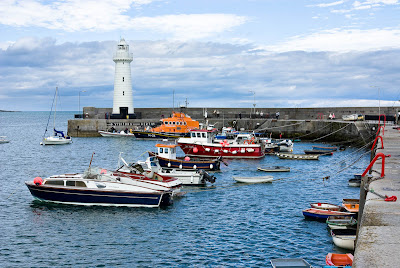
The same mixture of change and stability applies to the landscape as well. Donaghadee is a small fishing village near Belfast. The old folk-song claims that it is “six miles from Bangor to Donaghadee” but that must have been before the ring road was built. Nowadays, it is a little further but once there, the scene is the same as it was when I visited as a little boy. Global positioning has probably made the lighthouse redundant but a lifeboat is still based in the harbor and adds a splash of special color.


In Belfast, the iconic gantry cranes at the Harland & Wolf shipyard also add a splash of color to the skyline. Sadly, they now preside over a relatively silent workplace. It looked like the yard was doing some repairs to a small jack-up rig. That didn’t need the services of these gigantic cranes. These beautiful neglected wrought-iron gates are a sign of the shipyard’s former prosperity. Their sad decay is likely to be an indicator of the fate of these cranes. The curse of geography that puts Ireland at the western edge of Europe has always added to costs and probably will continue to doom the yard to slow decline.