Showing posts with label Pentax. Show all posts

Sunday, August 10, 2008

From the auld country

There are lots of direct flights between Houston and Gatwick. However, a detour via Newark allowed a stop in Belfast to visit my aging mother and offered a reduction in the ticket cost. That opportunity to be a dutiful son and a cost-conscious employee is too good to be missed.

Northern Ireland is a strange mixture of change and stability. On the side of “change” guided bus tours transport camera-clicking visitors up the Falls and down the Shankill to record the sectarian murals that that are now tourist attractions. On the side of stability and “nothing changes” are the loyalist flags remaining from the recent celebration of “the Twelfth” and the news reports that the “Apprentice Boys” marched at Londonderry (or Derry) yet again on Saturday.
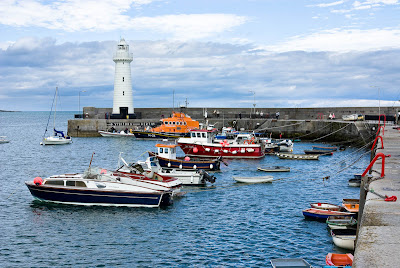


The same mixture of change and stability applies to the landscape as well. Donaghadee is a small fishing village near Belfast. The old folk-song claims that it is “six miles from Bangor to Donaghadee” but that must have been before the ring road was built. Nowadays, it is a little further but once there, the scene is the same as it was when I visited as a little boy. Global positioning has probably made the lighthouse redundant but a lifeboat is still based in the harbor and adds a splash of special color.


In Belfast, the iconic gantry cranes at the Harland & Wolf shipyard also add a splash of color to the skyline. Sadly, they now preside over a relatively silent workplace. It looked like the yard was doing some repairs to a small jack-up rig. That didn’t need the services of these gigantic cranes. These beautiful neglected wrought-iron gates are a sign of the shipyard’s former prosperity. Their sad decay is likely to be an indicator of the fate of these cranes. The curse of geography that puts Ireland at the western edge of Europe has always added to costs and probably will continue to doom the yard to slow decline.

Wednesday, July 9, 2008

Just Gulls

I have been remiss in writing this blog because other things have taken priority. Even the camera had to take a back seat recently. Last weekend was the first opportunity to try out a couple of lenses that a friend from church passed on to me. These had been unused for years after his broken Pentax film camera was pronounced uneconomic to repair. But, a feature of Pentax DSLR cameras is that they will operate with most old Pentax lens and so I gratefully attached them to the K10D and tried my hand at photographing the gulls on Galveston beach. It was a learning experience and as I deleted over 60 percent of the shots I was glad that I was not paying for film.

Looking at some of the initial “keepers” I noticed marks and smudges at the same position on each image. There was dirt on the camera sensor. Being able to make “repairs” with Lightroom software reinforced the joys of shooting digital. Hopefully, this weekend will offer another chance to practice with that zoom lens and capture the Laughing Gulls - this time with a clean sensor.

Thursday, April 24, 2008

To post or not to post . . . that is the question


There is no political content today. At least, that is the intention as I start to write this epistle.

During the past few years our neighbor’s sons have been members of St. Thomas Episcopal School's famous pipe band. J and I attended several past performances of the school’s Scottish Festival. My Pentax K10D arrived back from repair just in time for the spectacle last Friday. Over the years I have struggled with mixed success to capture good images of the performance. I have also struggled with the whole concept of proper use of photographs of somebody else’s children. This is especially true in today’s world where it is common to post pictures on the Web. Few Web systems offer any promise that postings can ever be completely deleted. Most web pages can be indexed, cached and stored forever by Google, Yahoo or one of the other search engines. With a little effort any user can download and store images and text displayed on their computer. It is both humbling and frightening. It is humbling because these words may already have been indexed by the time that you read them. It is frightening because people who are embarrassed or hurt by the content of a web page cannot easily have that problem erased or corrected. Posting on the web might almost be the modern equivalent of carving in stone.

And so my images of the Scottish Festival are destined to remain in the dark. The images from the Pentax were much higher quality than those from the old Olympus. That was expected. They taught be a little more about what works in that mixture of dark backgrounds and intense spotlights. They also suggest a compromise – an “artistic” shot that tries to capture the color, rhythm, beauty and excitement of the evening while cloaking the individual performers in mystery. I think that will be the objective for next year.

Wednesday, March 5, 2008

The camera doesn't lie . . . . Right!


Image manipulation is not new. Anyone who has watched a TV series about Henry VIII knows the problems caused by a flattering portrait. Holbein painted one of Anne of Cleves and showed it to Henry. Henry agreed to the marriage but when he finally met his betrothed he called her a “fat Flanders mare”. History suggests that Holbein exercised too much artistic license. Today, we take photo manipulation almost for granted. Of course, photographs have always been manipulated. There are the classic examples from the early Soviet era. Former party faithful who fell from favor were not only physically removed. Their images were skillfully airbrushed from any group photographs and history was rewritten. Less dramatically, photographs of movie stars and politicians and all those beautiful people in magazine ads are also retouched. In every photographic studio creative lighting enhanced features, clever poses hid signs of too many calories and double chins were banished with a raised head and flattering camera angle.

Lighting choices, lens type and camera viewpoint are still powerful tools. They still require skill to use. At another level, digital cameras and simple software have given everyone with a computer the power to change photographs. Most of us use these tools with little thought. “Red-eye” correction and removing skin blemishes are every-day examples. Blurring the skin to reduce wrinkles, brightening teeth and removing stray hair could be considered simple courtesy for a lady. But where does courtesy end? When do we become a twenty-first century edition of Holbein? Today, I can buy a program that will restore skin texture, remodel the nose, contour chin and cheeks, adjust the brow and hairline and enhance the eyes – all with a few clicks of a mouse. The final image is an artistic masterpiece – but is it still a photograph? Equally important, does it matter if the subject is happy with the result?

It is a fool-hardy blogger who would post portraits and confirm that the camera was lying. Those concerns do not apply to flowers. The image above was taken early in the morning with a macro lens and a small aperture for good depth of focus. Those choices started the manipulation before the shutter was pressed. The geranium below was taken in the afternoon using a very fast telephoto lens to achieve a shallow depth of focus and a fuzzy background. The photograph was also de-saturated to give a pastel appearance. Those choices yield very different images. As for the saxophonist at the beginning, he was left in peace to play cool jazz – only the backgrounds were slightly modified to return the buildings to vertical.

Wednesday, February 13, 2008

Quiet subjects

I was taking photographs at a church event last Sunday morning when the need to plough through the instruction manuals that came with my digital camera was driven home. The event was held in a well-lit “fellowship” room. Even so, I used flash to ensure that shutter speeds were fast enough to freeze movement. I also used a 31mm f/1.7 prime lens. On the K10D that lens provides coverage very close a standard 50mm lens in a 35mm film camera. It is wide enough to capture good groups and long enough so that the camera is not stuck under the subject’s nose. J gave me this lens as a Christmas present and it is wonderful. It is legendary within the Pentax fold for sharpness at wide apertures. Even so, I decided to “stop-down” to make sure I had sufficient depth of field to keep everyone in a group in focus. With flash working I started to the first batch of photographs. Horrors – when I checked the results some time later they were all taken at f/1.7. The point of focus was sharp as expected from this lens but people standing near by were blurry. It was then that I noticed the camera was set to “Program” mode. Instead of following my careful settings it was following another set of instructions buried deep in the set-up menus. A turn of the dial imposed human control and I took the final images the way I planned.
I appreciate the assistance that modern cameras provide. I don’t want to give up my integrated light meter or auto focus. But as Sunday proves, these aids can be subversive especially with subjects that only offer one chance to take the shot. For me, those are usually people. Maybe that is why I love photographing flowers. They don’t move. They don’t get bored waiting while I compose the shot and they patiently continue to look beautiful if I want to repeat the shots from a slightly different viewpoint. Most of my human subjects loudly complain if the picture is not taken when they say “cheese”. The dragonfly above was in my back yard. The orchid below is growing in my son’s new greenhouse in North Carolina. Both were very, very patient.

Sunday, February 3, 2008

Serendipity not Perspicacity

It is easy to get lost in politics. It is even easier to imagine that you have the answers to the nation’s problems. Maybe that is why multi-millionaires are happy to spend their money seeking a job that pays $400,000 and why others vie to be Vice President and earn $186,000 per year. So for this epistle I intend to return to photography.

There are several web sites that keep track of the vast number of digital cameras in the shops. One I regularly watch is Digital Photography Review. Just about every camera on the market today is capable of taking perfect photographs. My Pentax K10D is “Highly Recommended”. With interchangeable lenses, this camera is probably better than the equipment used most past photographers who have had their work printed. So why don’t my photographs show that quality?

I am sure that good photographs are a combination of three things: technique, hard work and creativity. Technique is the easy part because it can be learnt. Hard work is more difficult. All photographers know about the special qualities of light around dawn and dusk. Photographing at dusk is easy but many amateurs rarely get up before dawn to be in the right place when the sun breaks through. In his book Galen Rowell tells of how he jogged in the thin Tibetan air to get to a location where the perspective placed the Potala at the base of a rainbow. That photograph is a masterpiece. Galen Rowell was a master photographer. His photographs confirm a motto in one of my old college organic chemistry books, “Perspicacity not Serendipity”.

One of my favorite Sci-Fi novels is “Glory Road”. This is a standard knight errant tale that happens to be set on distant planets. The hero fights dragons, recovers the lost treasure and wins the girl – who just happens to be Empress of multiple universes. What makes this novel so interesting is that it does not end with the hero living happily ever after. He becomes bored with nothing to do. Even with all that wealth his life has no purpose. In one telling episode the hero describes his attempt to create jewelry. He has gemstones without limit but his creations lack sparkle. He lacks that gift of creativity.

There are times when I feel that way about my photographs. I have the tools and I work on the technique. Sometimes, I even put in the hard work necessary to be in the right space at the right time. Even so, like the creations of that hero in Glory Road, most of my results lack sparkle. But all is not yet lost. The great advantage of the digital camera is the “delete button”. There is always another day, another subject and another sunrise.


This sunset was taken from a hotel room in Puerto la Cruz, Venezuela. All the rooms in this hotel look out onto the bay and I have stayed there several times during business visits to Venezuela. On most trips the sun had set by the time I got back to the room but this time the meetings finished early. With camera at the ready I watched the sun disappear behind a bank of low cloud. I was convinced that there would be no color that night. I was about to change lens and focus on that boat in the foreground when the clouds flared into color. This photograph is the result – the only requirement, some technique.

Thursday, January 3, 2008

Too Much Information

Tower Bridge (E-10)
Setting up this blog started me thinking again about digital cameras and megapixels. My hobby is photography and I switched from film to digital back in 2002. My first digital camera was an Olympus C-2100UZ. It had a 2-megapixel chip but sported a large 10x zoom lens. That lens was stabilized making it easier to take sharp photographs at the longer zoom range. I used that camera for several years both for pleasure and at work. I discovered that 2 megapixel photographs were the ideal size for inclusion in reports. Printed at 300 pixels per inch, two photographs from that camera could fit perfectly onto a standard 8.5 x 11 inch page and still leave room for headings and titles. Equally important, the zoom lens allowed each picture to be properly composed in the viewfinder. None of those precious pixels were wasted.

Time, technology and pixel envy wait for no man and my next camera was another Olympus; the legendary E-10. This was a step-up in quality from the C-2100UZ. It had 4 megapixels and another wonderful lens. However, the zoom was only 4x. Those extra pixels were wonderful and when the image used every one I was able to make large detailed prints. Several 11 x 14 inch prints taken with this camera grace the walls of my office. When the subject was not perfectly framed, those extra pixels gave limited ability to correct the composition. Unwanted portions could be cropped and still leave enough pixels to illustrate an email or print a decent snap-shot.

Today, I use a Pentax K10D digital single lens reflex camera. I bought my first Pentax film camera in 1977 and I have remained a fan of the brand ever since. The K10D is everything I need. It also has backward compatibility to over 24 million past and present Pentax lenses. I know I will never really outgrow that system. The SLR format lets me select (or covet) the best lens for the composition and 10 megapixels give me great latitude if there is a need to crop the image in the “digital darkroom”.

The net result is that today my photographs are usually blessed with too much information. Yes, those extra pixels let me make very large prints; and I have used them all - about three times! Normal 4 x 6 prints don’t need any more pixels in 2008 than they did in 2002 when I had a 2 megapixel camera. Neither do illustrations in reports for work. Many web sites (even the Pentax Gallery or photoSIG) positively prohibit large files and common courtesy requires that the files be made smaller before the photos can be attached to an email. Now, instead of searching for the best software to enlarge my files I find that I am using similar programs to efficiently delete the pixels I have spent so much time and effort trying to faithfully record. Technology advances bring some strange problems - especially as wild horses would not make me give up those extra pixels. I just know they will all come in useful next time I use the camera!