Monday, August 25, 2008

Doors

This gate at the Harland & Wolf shipyard in Belfast continues to pique my interest. To me, the iron retains its strength and beauty but as I look at the photograph I could kick myself for not taking more time to study the construction. Some parts of the gate look like wrought iron while others are clearly cast. Where they made in the shipyard or is there a name of an artist or foundry inscribed somewhere among those weeds? When were they fabricated? I assume it was sometime after WW II because most ornamental iron railings and gates were collected at the start of the war and turned into steel for munitions. I hope they are still there next time I visit Belfast and I can get some answers.

Doors hold a fascination for me. There are intrinsic differences in function, form, and construction. Equally, doors are wonderful metaphors. What allusions can be drawn from a neglected shipyard gate surrounded by rampant weeds?

The last couple of doors are from churches. The first is at the church located in Jerusalem where the Pool of Siloam is thought to have been. Those closed doors reminded me of the quatrain by Omar Khayyam:

There was a Door to which I found no Key:
There was a Veil through which I could not see:
Some little Talk awhile of Me and Thee
There seemed -- and then no more of Thee and Me.

The second is at one of the missions in San Antonio. I really don’t think there is any significance to the fact that one is open while the other is closed. But then, that’s what makes doors such a fascinating subject – they make me think.


Sunday, August 10, 2008

From the auld country

There are lots of direct flights between Houston and Gatwick. However, a detour via Newark allowed a stop in Belfast to visit my aging mother and offered a reduction in the ticket cost. That opportunity to be a dutiful son and a cost-conscious employee is too good to be missed.

Northern Ireland is a strange mixture of change and stability. On the side of “change” guided bus tours transport camera-clicking visitors up the Falls and down the Shankill to record the sectarian murals that that are now tourist attractions. On the side of stability and “nothing changes” are the loyalist flags remaining from the recent celebration of “the Twelfth” and the news reports that the “Apprentice Boys” marched at Londonderry (or Derry) yet again on Saturday.


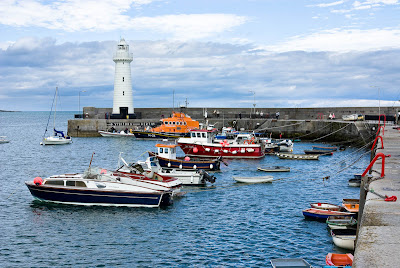
The same mixture of change and stability applies to the landscape as well. Donaghadee is a small fishing village near Belfast. The old folk-song claims that it is “six miles from Bangor to Donaghadee” but that must have been before the ring road was built. Nowadays, it is a little further but once there, the scene is the same as it was when I visited as a little boy. Global positioning has probably made the lighthouse redundant but a lifeboat is still based in the harbor and adds a splash of special color.


In Belfast, the iconic gantry cranes at the Harland & Wolf shipyard also add a splash of color to the skyline. Sadly, they now preside over a relatively silent workplace. It looked like the yard was doing some repairs to a small jack-up rig. That didn’t need the services of these gigantic cranes. These beautiful neglected wrought-iron gates are a sign of the shipyard’s former prosperity. Their sad decay is likely to be an indicator of the fate of these cranes. The curse of geography that puts Ireland at the western edge of Europe has always added to costs and probably will continue to doom the yard to slow decline.

Tuesday, July 22, 2008

Flying

Modern cameras are wonderful. Automatic exposures, automatic focus and shake reduction tempt one to mount a long zoom, point and shoot. I have been doing just that as I walked along the beach at Galveston snapping birds. The results were not very satisfactory. By taking lots of shots the law of averages came to my assistance and I was able to find some that were worth keeping. However, none captured the feelings I was hoping for. Last weekend, I thought about some of the basic photography principles that apply to the shots I was trying to take.

First, I was using a 70-210mm zoom lens set at maximum zoom. On the Pentax K10D this lens has the same properties as a 100-300 mm zoom on 35 mm film camera. For reasonable sharpness, the rule of thumb is to set the minimum shutter speed at 1/focal length. For my lens that should have been at least 1/300 of a second. In “automatic” mode my camera was setting the shutter speed to 1/250 of a second. That’s not a big difference if my subjects had not been moving but it was likely enough to cause some of the blurred details I was seeing. So last weekend I took back some control. I set the shutter speed to 1/500 of a second. I also increased the ISO setting from 100 to 200 so that the f-stop and depth of focus didn’t change. This guy is close to what I have been looking for.


I am in awe of the way the gulls are so at ease as they float on the sea breezes. Just a flick of a feather is enough to set them gliding over the waves to capture a different air current. High over the beach, frigate birds wheeled and turned last Sunday. They were just like so many U2 spy planes while lower down, squadrons of pelicans made effortless “Dawn patrols” along the shore line. They are all in total control of every puff of air. It is easy to understand why we are so fascinated by flight.

As I sat watching them I remembered a poem written in 1941 by an Anglo-American pilot who flew a Spitfire in England for the RCAF. This was before the USA entered WW II. He was killed a couple of months later in an air crash. President Regan quoted the ending stanza after the Challenger disaster, but the earlier lines capture the sheer exhilaration of flying. I know those birds feel that exhilaration.

High Flight
Oh! I have slipped the surly bonds of earth
And danced the skies on laughter-silvered wings; Sunward I've climbed, and joined the tumbling mirth Of sun-split clouds - and done a hundred things You have not dreamed of - wheeled and soared and swung High in the sunlit silence. Hov'ring there I've chased the shouting wind along, and flung My eager craft through footless halls of air. Up, up the long delirious, burning blue, I've topped the windswept heights with easy grace Where never lark, or even eagle flew - And, while with silent lifting mind I've trod The high untresspassed sanctity of space, Put out my hand and touched the face of God.

Pilot Officer John Gillespie Magee
No 412 squadron, RCAF, 1941

Thursday, July 17, 2008

More thoughts on oil supply – and still no pictures

“Fungible” is an interesting word. The dictionary defines it as “being of such nature or kind as to be freely exchangeable or replaceable, in whole or in part, for another of like nature or kind.” Crude oil is a fungible commodity. Differences in quality affect prices and influence the best refinery for processing. But, in simple terms the world’s supply of crude oil can be considered as one large pot. Picture the producers pouring their oil into the pot and the users sitting around like kids sucking it out with straws. New discoveries make the pot bigger. Increasing demand is just those users sucking harder.

So what happens when we discover all that oil offshore that our politicians keep talking about? If the discoveries are big enough to meet our needs and we keep it to ourselves we become independent. That is a dream. More likely, discoveries will be much less than our needs. Again, if we keep that oil to ourselves we may not have to suck so hard from the communal pot. As Mr. Micawber’s economics suggested, we might achieve happiness. More likely, others will suck what we leave and there will be no change in the price of oil.

People are beginning to realize and accept that it will take five to ten years to develop any oil found in the new drilling areas. I wonder if they realize how much oil they will need to find to make any difference. This table shows some numbers taken from the data on the US Department of Energy website. I’ve selected the figures from 2007 and also those forecast for 2015 – when those “discoveries” might be arriving at the pump.

This table only shows three countries – USA, India and China. I have assumed that conservation allows us to reduce our oil consumption by 10 percent in the next 7 years. I have also assumes that India and China will only increase their oil per capita consumption by 10 percent during this time. (As the people of India and China become more affluent they will rightly expect the same standards as those of the West. My assumption of their demands may be very low). Adding the daily demands of just these three countries we see that it grows from 31 million barrels in 2007 to 36 million barrels in 2015. That pot will need to grow by an extra 5 million barrels per day just to meet the needs of US, China and India.

The largest oilfield in the USA is Prudhoe Bay in Alaska. It produces about 400,000 barrels per day. The biggest oilfield in the world is the Ghawar field in Saudi Arabia. Even it only produces about 4 million barrels of oil each day. The whole of Iran produces only 4 million barrels per day. Our politicians might hope the oil industry can discover another Prudhoe Bay. It is statistically unlikely that they will find another Ghawar. The demands of people sucking from that communal oil pot are getting bigger each day. It is obvious that the solution to our (and the world’s) energy problems has to be found outside the oil industry.

Monday, July 14, 2008

Thoughts on Oil - and no pictures

Wilkins Micawber in Charles Dickens’ novel, David Copperfield is famous for his statement, “Annual income twenty pounds, annual expenditure nineteen nineteen six, result happiness. Annual income twenty pounds, annual expenditure twenty pounds ought and six, result misery.

The website of the Energy Information Administration allows us to apply this principle to crude oil prices. Data published on July 8, 2008 show world petroleum production of 86.48 million barrels per day. World consumption is calculated at 86.40 million barrels per day. If these figures are accurate the result for 2008 should be happiness. Forecasts for 2009 are not so rosy. World petroleum consumption is estimated to be 87.72 million barrels per day and consumption will be 87.76 million barrels per day. Mr. Micawber’s statement suggests misery in 2009. Obviously, nobody believes Government statistics for 2008 so crude oil is priced above $140 per barrel instead of happier levels. Misery could be here to stay.

Micawber logic predicts that happiness will only return if we increase production or reduce consumption. Our politicians have made loud proclamations about increasing production. They talked about drilling off the East and West Coasts and in the Alaskan Natural Wildlife reserve. A few sensible ones noted that even if this drilling found oil tomorrow it would probably take seven or eight years to bring the new oil to market. Domestic drilling is not going to restore the production/consumption balance. Overseas production increases might be possible in a shorter timetable. Venezuela’s Orinoco basin has about 1.2 billion barrels of extra-heavy oil in place. Venezuela exports about half a million barrels per day of this oil. The Venezuelan government has plans to significantly increase this volume. However, even here, where the oil location is known, the extraction technology is proven, and the environmental concerns are easily addressed, new production will take at least six years to come on stream. A similar situation probably exists in Saudi Arabia where increasing production from declining oil fields is unlikely to be as easy as the newspapers imply.

A different chorus of folks has stated, “we can’t drill our way out of this crisis”. If they had qualified this sound bite by adding “in any realistic timetable and at a reasonable price” they would probably be more correct. (But $145 dollar oil and lots of time can make even harebrained schemes look sensible.) The real answer for us is to reduce our consumption. In the US we use vast quantities of petroleum compared to other nations. We consume 20.7 million barrels per day compared to China’s 6.5 and India’s 2.4 million barrels per day. On a per capita basis those statistics look even worse. We use 70.6 barrels/1,000 people per day. China uses 2.3 and India 5.1. As the living standards in those countries continue to rise demands for petroleum will also increase – maybe to levels like the 30 - 40 barrels /1,000 people used by many countries in Europe? For the long run, it is unlikely that there will ever be enough oil again to satisfy Mr. Micawber’s requirements for happiness.

Wednesday, July 9, 2008

Just Gulls

I have been remiss in writing this blog because other things have taken priority. Even the camera had to take a back seat recently. Last weekend was the first opportunity to try out a couple of lenses that a friend from church passed on to me. These had been unused for years after his broken Pentax film camera was pronounced uneconomic to repair. But, a feature of Pentax DSLR cameras is that they will operate with most old Pentax lens and so I gratefully attached them to the K10D and tried my hand at photographing the gulls on Galveston beach. It was a learning experience and as I deleted over 60 percent of the shots I was glad that I was not paying for film.

Looking at some of the initial “keepers” I noticed marks and smudges at the same position on each image. There was dirt on the camera sensor. Being able to make “repairs” with Lightroom software reinforced the joys of shooting digital. Hopefully, this weekend will offer another chance to practice with that zoom lens and capture the Laughing Gulls - this time with a clean sensor.

Friday, May 23, 2008

Gratuitous plugs - no politics

At one time “diplomacy” was defined as discussion, persuasion and maybe even subtle coercion used to reach national goals. It required meeting and talking with people of different viewpoints and ambitions. In extremes, it was even necessary to deal with people who sought your ruin. Diplomacy was the skill of solving problems without the use of overt force. In recent years, US leaders have abandoned this traditional definition of diplomacy. Now, our top leaders revile and insult anyone who proposes to meet with people who actively oppose us and can be defined as “terrorists”. Our diplomatic skills are reduced to meeting with those who share our opinions and bombing those who don’t! But just as the decline in the value of the dollar has reduced US world economic influence, so this decline in our diplomatic skills reduces our ability to influence world events. We have lost our position of a respected leader. Our politicians now act more like loud-mouthed bullies.

I was going to continue with examples of respected past leaders who had real diplomatic skills. These leaders dealt with people who might today be called terrorists (or worse) to gain our national objectives. But why should I waste time? The blunders of our current leadership are obvious to anyone with an IQ over 85. This includes diplomacy. Instead, the rest of this epistle is a gratuitous plug for bull terriers.


In many places bull terriers get a bad rap. J’s family had bull terriers when she was a girl and they have always been an important part of our family. We currently share our life with Harvey. This photo was taken after he had a cyst removed from his neck. Harvey is a miniature white English bull terrier. He is instantly recognized by anyone who watched certain beer adverts or who shops in Target. Harvey is small in stature but he displays all the personality and character traits that make bull terriers so loved. Harvey also displays some of the other qualities that can make bull terriers so misunderstood. On the positive side, he is a loving 30-pound lap dog. He is happiest when he is cuddled up beside me watching TV. Harvey behaves just like a strong-willed child. He is precocious, disobedient and is always trying to have things his way. There is nothing in Harvey’s character to give any concern that he would hurt anyone. But, Harvey is a bull-terrier. He is built like an Abrams tank. Those 30 pounds are all solid muscle and bone. His jaws are like a clamp and his tail thrashes from side to side like a cudgel. Harvey doesn’t go around obstructions. He goes through them or shoves them aside. Harvey is like a sumo wrestler who has not learnt to control his strength. This can be a problem when he meets new people, especially young people. Small children are likely to be overwhelmed (and overturned) by his affectionate greetings. For that reason, we always keep Harvey under close control when children ask to meet him.

Harvey is the latest in a line of Bull Terriers and Pit Bulls who have shared our home. They each deserve their own entry in this blog, especially Cleopatra, a red-nosed red Pit Bull and a gentle soul. Throughout her life Cleopatra was ruled by our small Burmese cat who was only one tenth her size. Harvey, Sparky, Cleopatra, Honey and Marquis were all dogs who shared our home at different times. In their dealings with J and me, our children, the neighborhood kids and visitors, these bull terriers showed me that bad dogs are rare – even (especially?) bull terriers. When a bull terrier goes bad, the fault is almost always with the owner.

The personality and character of most bull terriers means that they are not the right dog for every family. Sensible dog lovers recognize this fact. The same statement can also be made for many other breeds – Rottweilers, German Shepherds, for example. Maybe a time is approaching when a dog license should be for a type and size of dog. Just as some people do not qualify for a firearms license, so some people should not be licensed to keep certain dogs. That may sound outrageous, but is it any more outrageous than the suggestion that diplomacy does not require we deal with those we call terrorists?