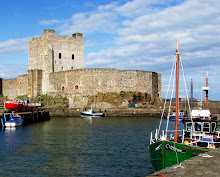

The retirement of Ian Paisley from Northern Ireland’s politics reminded me of a conversation I had in South Africa some years ago. Travelling from the industrial complex at Secunda to Johannesburg I chatted with the driver about the changes in his country. He provided a simple picture to explain how South Africa was able to move from the violence of apartheid towards an integrated society. His model was a three-legged stool. In his story, one leg of the stool represented the extreme whites who wanted to continue with apartheid. One leg represented the extreme blacks who wanted to violently overthrow this system. The third leg represented the majority of the people – black and white. They just wanted to get on with living and provide a better future for their children. My driver reminded me that a three-legged stool falls if one leg is missing. In the same way South Africa’s conflict could only be resolved if these three parties all agreed to change. His first key to getting change was the condition of the legs. The population must be tired of the status quo and must really want something different. The opposing leaders must both have spotless political credentials. They must also have courage to lead their group of extremists along the new path. His second key to change is that all three legs must be present at the same time. That second key is why real political change is so rare.
As we drove through the darkness he told me that in old South Africa there was general unrest among all people. The lack of progress under apartheid was having an impact on everybody’s life. People wanted to change. He then noted the courage and vision of President F.W. de Klerk. This white leader’s history and politics allowed him to stifle any serious arguments from his followers. Finally, Nelson Mandela was loved and revered by the black community. His struggle against oppression was legendary. He had the moral authority to ask his followers to accept the changes. All three legs were together at that moment in South Africa’s history. Change happened. South Africa surprised the world with its peaceful revolution.
More recently, we saw the same thing happen in Northern Ireland. The majority of the people in Northern Ireland have been ready for an end to “the troubles” for many years. That was demonstrated when Mairead Corrigan and Betty Williams won the Nobel Peace Prize in 1976. Also, for many years, Ian Paisley has been a strong and charismatic leader for the ultra Loyalists. Only the Republican leg of the stool lacked a single leader with similar stature. That leader finally came into the picture when Gerry Adams emerged and grew as spokesman and leader for Sinn Fein. The stool now had three legs. Change became possible and Power Sharing and peace got off to a creaky start.
As I apply this analysis to other crises, the picture for 2008 is not encouraging. The Israeli-Palestine stool almost had all three legs at the same time a few years ago. Change was nearly within the grasp of both sides of Abraham’s family. Now, I fear that both the leadership legs are missing and all the rhetoric and cajoling from Washington is just adding more hot air to the desert winds. In Iraq the leadership leg for the Sunni faction is missing and that for the Shiite majority looks wobbly. In Afghanistan, all three legs are waiting to be discovered. I took the picture above during a visit to Belfast. The few remaining murals have now become tourist attractions. I pray for the day when each three-legged stool in the Middle East find all of their legs and the Jerusalem Wall can follow the way of the Berlin Wall and these murals.
As we drove through the darkness he told me that in old South Africa there was general unrest among all people. The lack of progress under apartheid was having an impact on everybody’s life. People wanted to change. He then noted the courage and vision of President F.W. de Klerk. This white leader’s history and politics allowed him to stifle any serious arguments from his followers. Finally, Nelson Mandela was loved and revered by the black community. His struggle against oppression was legendary. He had the moral authority to ask his followers to accept the changes. All three legs were together at that moment in South Africa’s history. Change happened. South Africa surprised the world with its peaceful revolution.
More recently, we saw the same thing happen in Northern Ireland. The majority of the people in Northern Ireland have been ready for an end to “the troubles” for many years. That was demonstrated when Mairead Corrigan and Betty Williams won the Nobel Peace Prize in 1976. Also, for many years, Ian Paisley has been a strong and charismatic leader for the ultra Loyalists. Only the Republican leg of the stool lacked a single leader with similar stature. That leader finally came into the picture when Gerry Adams emerged and grew as spokesman and leader for Sinn Fein. The stool now had three legs. Change became possible and Power Sharing and peace got off to a creaky start.
As I apply this analysis to other crises, the picture for 2008 is not encouraging. The Israeli-Palestine stool almost had all three legs at the same time a few years ago. Change was nearly within the grasp of both sides of Abraham’s family. Now, I fear that both the leadership legs are missing and all the rhetoric and cajoling from Washington is just adding more hot air to the desert winds. In Iraq the leadership leg for the Sunni faction is missing and that for the Shiite majority looks wobbly. In Afghanistan, all three legs are waiting to be discovered. I took the picture above during a visit to Belfast. The few remaining murals have now become tourist attractions. I pray for the day when each three-legged stool in the Middle East find all of their legs and the Jerusalem Wall can follow the way of the Berlin Wall and these murals.


 Why do I mention Aunt Edie? In recent months the subject of immigrants, border fences and national security has filled the airways. Aunt Edie is an example of past times. Coming from Ireland she was a textile worker. That was probably a useful profession in 1929. When she applied for that visa she was sure that immigrating to USA would give her a better life than staying in Belfast. I know that thought pattern continues today. People only leave home when the benefits on the other side of the fence are clearly better. For Aunt Edie, the ties to home were more powerful than the greener grass across the Atlantic. Every day, immigrants to USA – legal and illegal – make that same calculation. Fences, even double fences will not stop immigration. They will only change the arithmetic of the decision to come.
 It is a fool-hardy blogger who would post portraits and confirm that the camera was lying. Those concerns do not apply to flowers. The image above was taken early in the morning with a macro lens and a small aperture for good depth of focus. Those choices started the manipulation before the shutter was pressed. The geranium below was taken in the afternoon using a very fast telephoto lens to achieve a shallow depth of focus and a fuzzy background. The photograph was also de-saturated to give a pastel appearance. Those choices yield very different images. As for the saxophonist at the beginning, he was left in peace to play cool jazz – only the backgrounds were slightly modified to return the buildings to vertical.

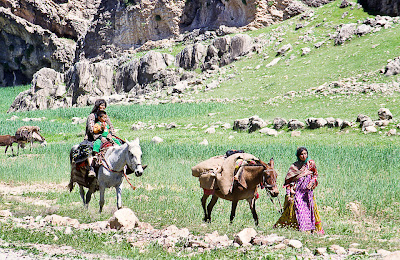 Cities are not the only things that change with time. People and lifestyles also change as we enjoy the “benefits” of progress. I photographed these Qashqai ladies one spring day as they moved with their family and flocks from the area around Shiraz in southern Iran. I wonder if the scene still exists today.
 But the traditional Japanese character still remains in Yokohama. Twenty years ago I was introduced to the simple pleasures of
  I appreciate the assistance that modern cameras provide. I don’t want to give up my integrated light meter or auto focus. But as Sunday proves, these aids can be subversive especially with subjects that only offer one chance to take the shot. For me, those are usually people. Maybe that is why I love photographing flowers. They don’t move. They don’t get bored waiting while I compose the shot and they patiently continue to look beautiful if I want to repeat the shots from a slightly different viewpoint. Most of my human subjects loudly complain if the picture is not taken when they say “cheese”. The dragonfly above was in my back yard. The orchid below is growing in my son’s new greenhouse in North Carolina. Both were very, very patient.