
There is no political content today. At least, that is the intention as I start to write this epistle.
During the past few years our neighbor’s sons have been members of St. Thomas Episcopal School's famous pipe band. J and I attended several past performances of the school’s Scottish Festival. My Pentax K10D arrived back from repair just in time for the spectacle last Friday. Over the years I have struggled with mixed success to capture good images of the performance. I have also struggled with the whole concept of proper use of photographs of somebody else’s children. This is especially true in today’s world where it is common to post pictures on the Web. Few Web systems offer any promise that postings can ever be completely deleted. Most web pages can be indexed, cached and stored forever by Google, Yahoo or one of the other search engines. With a little effort any user can download and store images and text displayed on their computer. It is both humbling and frightening. It is humbling because these words may already have been indexed by the time that you read them. It is frightening because people who are embarrassed or hurt by the content of a web page cannot easily have that problem erased or corrected. Posting on the web might almost be the modern equivalent of carving in stone.
And so my images of the Scottish Festival are destined to remain in the dark. The images from the Pentax were much higher quality than those from the old Olympus. That was expected. They taught be a little more about what works in that mixture of dark backgrounds and intense spotlights. They also suggest a compromise – an “artistic” shot that tries to capture the color, rhythm, beauty and excitement of the evening while cloaking the individual performers in mystery. I think that will be the objective for next year.
During the past few years our neighbor’s sons have been members of St. Thomas Episcopal School's famous pipe band. J and I attended several past performances of the school’s Scottish Festival. My Pentax K10D arrived back from repair just in time for the spectacle last Friday. Over the years I have struggled with mixed success to capture good images of the performance. I have also struggled with the whole concept of proper use of photographs of somebody else’s children. This is especially true in today’s world where it is common to post pictures on the Web. Few Web systems offer any promise that postings can ever be completely deleted. Most web pages can be indexed, cached and stored forever by Google, Yahoo or one of the other search engines. With a little effort any user can download and store images and text displayed on their computer. It is both humbling and frightening. It is humbling because these words may already have been indexed by the time that you read them. It is frightening because people who are embarrassed or hurt by the content of a web page cannot easily have that problem erased or corrected. Posting on the web might almost be the modern equivalent of carving in stone.
And so my images of the Scottish Festival are destined to remain in the dark. The images from the Pentax were much higher quality than those from the old Olympus. That was expected. They taught be a little more about what works in that mixture of dark backgrounds and intense spotlights. They also suggest a compromise – an “artistic” shot that tries to capture the color, rhythm, beauty and excitement of the evening while cloaking the individual performers in mystery. I think that will be the objective for next year.


 As a friend remarked in Sunday school last week, “We are not called to change the world but we are responsible for our own actions”. So, I shall not be participating in the 2008 Olympics. I shall not watch the television coverage and I shall not buy products from companies that support the games. I know my decisions will have absolutely no affect on China’s human rights policies or how the games evolve. But I remain a true optimist. I remember how Horiatio and his two companions held the bridge and saved Rome, how the 300 Spartans helped defeat the Persian invaders and how the defenders of the Alamo bought time for Texas. Maybe, just maybe, my little gesture will encourage others and like these photographs of two different sides of the Texas story, a gesture doomed to defeat can lead to change. Maybe also, that spokesman’s comment will awaken all the presidential candidates to our nation’s real weakness - a weakness caused because we are so indebted to foreigners that we have no freedom to act as we choose.


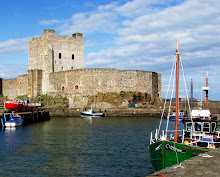
 Why do I mention Aunt Edie? In recent months the subject of immigrants, border fences and national security has filled the airways. Aunt Edie is an example of past times. Coming from Ireland she was a textile worker. That was probably a useful profession in 1929. When she applied for that visa she was sure that immigrating to USA would give her a better life than staying in Belfast. I know that thought pattern continues today. People only leave home when the benefits on the other side of the fence are clearly better. For Aunt Edie, the ties to home were more powerful than the greener grass across the Atlantic. Every day, immigrants to USA – legal and illegal – make that same calculation. Fences, even double fences will not stop immigration. They will only change the arithmetic of the decision to come.
 It is a fool-hardy blogger who would post portraits and confirm that the camera was lying. Those concerns do not apply to flowers. The image above was taken early in the morning with a macro lens and a small aperture for good depth of focus. Those choices started the manipulation before the shutter was pressed. The geranium below was taken in the afternoon using a very fast telephoto lens to achieve a shallow depth of focus and a fuzzy background. The photograph was also de-saturated to give a pastel appearance. Those choices yield very different images. As for the saxophonist at the beginning, he was left in peace to play cool jazz – only the backgrounds were slightly modified to return the buildings to vertical.

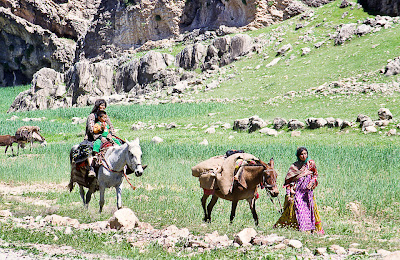 Cities are not the only things that change with time. People and lifestyles also change as we enjoy the “benefits” of progress. I photographed these Qashqai ladies one spring day as they moved with their family and flocks from the area around Shiraz in southern Iran. I wonder if the scene still exists today.